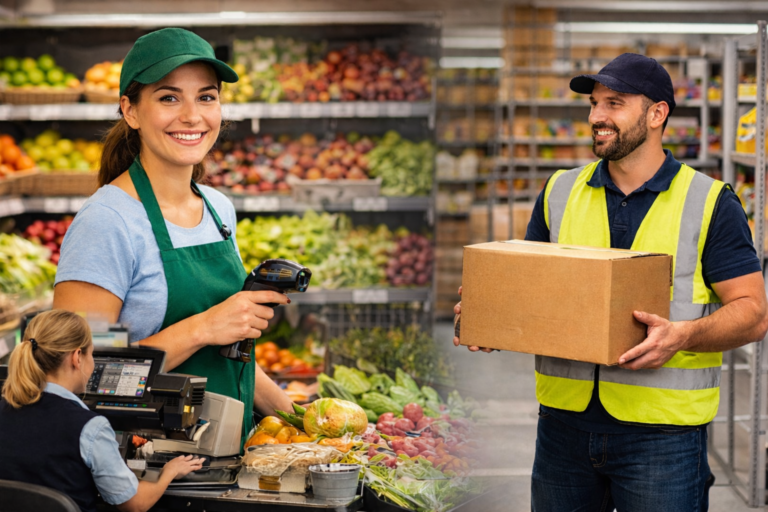
For those seeking a first job, professional repositioning, or stability in the retail sector.
Main Employment Areas at Sainsbury’s
Physical stores
Physical stores concentrate the majority of hiring. It is in them that the most accessible positions and the highest volume of vacancies throughout the year are found.
Distribution centers
Distribution centers are responsible for supplying the stores. Therefore, these units require a constant workforce, especially for logistical roles.
Logistics and deliveries
With the growth of online shopping, the delivery area has become one of the most important within the company, generating new roles and expanding the number of vacancies.
Administrative areas
On a smaller scale, Sainsbury’s also has administrative, corporate, and technical positions, usually located in regional or central offices.
Store positions at Sainsbury’s (explained in detail)
Stores are, without a doubt, the main entry point for those who want to work at Sainsbury’s. Below are the most common positions, with detailed explanations of each role.
Customer Assistant (Store Assistant)
The Customer Assistant is one of the most important roles within the store. This professional works directly with customer service, assisting with locating products, answering questions, and ensuring a good shopping experience.
In addition, the assistant may also help organize shelves, check product expiration dates, and support other store areas. It is a dynamic role that requires good communication, attention, and physical readiness.
For this reason, it is a position highly recommended for those starting out, as it does not require prior experience and offers complete training.
Checkout Assistant (Cashier)
The Checkout Assistant is responsible for operating the checkout, registering purchases, receiving payments, and finalizing customer service. Although it may seem simple, this role requires concentration, agility, and courtesy.
In addition, the cashier represents the customer’s final contact with the store. Therefore, the company places high value on professionals who are polite, organized, and attentive to internal procedures.
In many cases, this role works on a shift system, including weekends and peak hours.
Replenishment Assistant (Shelf Stocker)
The replenishment assistant works directly with restocking products on the shelves. Their job ensures that the store is always stocked, organized, and visually attractive to customers.
Typically, this role involves moderate lifting, constant movement, and attention to expiration dates. Additionally, in some shifts, the work takes place outside peak hours, such as overnight or early morning.
It is a role that is highly sought after by those who prefer less direct contact with the public.
Stock Assistant (Stockroom Assistant)
The Stock Assistant works behind the scenes of the store, organizing stock, receiving merchandise, and assisting with the internal distribution of products.
Although not always in direct contact with customers, this professional needs to be organized, attentive, and efficient. After all, poorly managed stock directly impacts the store’s operations.
This position is common in larger stores and usually requires good physical stamina.
Bakery Assistant
The bakery assistant works in the preparation, replenishment, and organization of bakery products. In addition, they may also serve customers at the counter, answer questions, and keep the area clean and organized.
It is a role that requires attention to hygiene standards and, at the same time, the ability to work with fresh food products.
Butcher / Fish Counter Assistant (Butchery and Fish Counter)
These professionals work at the meat and fish counters. Their duties include customer service, product cutting, counter organization, and strict compliance with sanitary standards.
Although, in some cases, experience is required, many stores offer internal training for beginners interested in these areas.
Store Cleaner (Cleaning)
The cleaning professional ensures that the store is always in proper hygiene and safety conditions. This includes sales areas, aisles, restrooms, and internal areas.
Despite being a less visible role, it is essential for store operations and usually has high demand.
Positions in distribution centers and logistics
Distribution centers are fundamental to Sainsbury’s operations. In these locations, the work pace tends to be more intense, but with less contact with the public.
Warehouse Operative
This professional works with the movement of goods within the distribution center. They organize products, separate orders, and ensure that everything is ready to be sent to the stores.
It is a role that requires physical endurance, attention, and strict compliance with safety standards.
Order Picker
The Order Picker is responsible for selecting products according to specific orders. This work requires agility, precision, and the ability to follow instructions carefully.
Generally, performance is measured by productivity, which makes the role more dynamic.
Forklift Driver
The forklift driver operates forklifts to move large volumes of goods. For this role, specific certification is required.
It is usually a better-paid position within logistics, precisely because it requires technical qualification.
Positions in the delivery area
With the growth of online shopping, delivery positions have gained prominence.
Delivery Driver
The delivery driver is responsible for delivering purchases directly to customers’ homes. In addition to driving, they represent the company’s image, as they maintain direct contact with consumers.
Good communication, responsibility, and punctuality are essential in this role.
Driver Assistant
The assistant helps with loading, unloading, and organizing deliveries, as well as supporting the driver during routes.
Entry programs and career start
Sainsbury’s offers apprenticeship programs and entry-level positions for those who are just starting out. These programs combine practical work with structured training, making it easier to adapt to the British market.
For this reason, they are highly sought after by young people, students, and immigrants.
General requirements to work at Sainsbury’s
In general, the company requires:
Legal right to work in the United Kingdom
Availability of working hours
Good communication
Ability to work in a team
For specific positions, certificates or licenses may be required.
Salaries and benefits (general overview)
Salaries vary according to role and region. Even so, Sainsbury’s usually pays values compatible with the market.
In addition, employees generally have access to:
Paid holidays
Internal discounts
Health benefits
Pension contribution
Sainsbury’s in the British labor market
First of all, it is important to understand the size of Sainsbury’s within the United Kingdom. The company is present in virtually all regions of the country, with large supermarkets, convenience stores, distribution centers, and a highly organized logistics structure.
In addition, Sainsbury’s employs tens of thousands of people, which means that new job openings are constantly being created. Consequently, even those who do not have previous experience in the United Kingdom find good chances of being hired, especially in operational roles.
At the same time, the company is known for maintaining clear processes, internal training, and real opportunities for growth, which attracts both beginners and more experienced professionals.
Professional growth within the company
One of the most attractive points of Sainsbury’s is the possibility of internal growth. Many professionals start in basic roles and, over time, take on leadership positions or move to other areas.
Working at Sainsbury’s is a real opportunity for those seeking employment in the United Kingdom, especially in retail and logistics. With a wide variety of positions, internal training, and growth opportunities, the company establishes itself as one of the main gateways to the British labor market.